
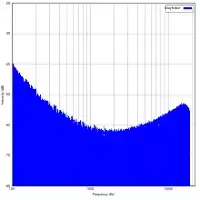
Six lossless FLAC noise files — pink, white, brown, gray, blue and violet
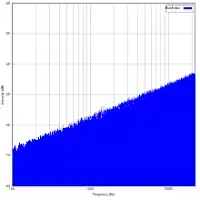
Blue Noise
Codec: flac
- DOWNLOAD
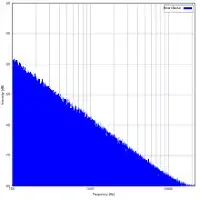
Brown Noise
Codec: flac
- DOWNLOAD

Gray Noise
Codec: flac
- DOWNLOAD
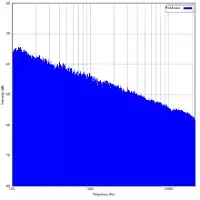
Pink Noise
Codec: flac
- DOWNLOAD
Violet Noise
Codec: flac
- DOWNLOAD
White Noise
Codec: flac
- DOWNLOAD
Pink noise and white noise look similar on paper — both are broadband, both cover the full audible spectrum, both get used for speaker testing and room measurement. The difference is in how their energy is distributed — and understanding pink noise vs white noise determines which one is actually useful for calibration.
Pink noise vs white noise — what actually differs
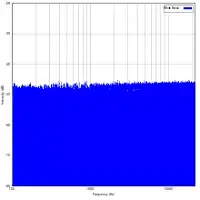
White noise has equal energy per hertz across the spectrum. That sounds balanced until you consider that each octave contains twice the frequencies of the one below it — which means white noise delivers twice the energy per octave as you go up. The result is a signal that sounds bright and skewed toward the top end — not because anything is wrong with it, but because that’s what equal energy per hertz actually sounds like to human ears.
Pink noise corrects for that. A 3dB drop per octave lines up with how hearing sensitivity changes across the spectrum, so each octave lands with equal weight rather than the upper ones dominating. To human ears, pink noise sounds flat. That’s why it’s the standard reference for speaker calibration, room measurement and acoustic analysis — it matches how we actually hear rather than how energy is physically distributed.
Brown, gray, blue and violet
Brown noise extends the rolloff to 6dB per octave — heavily bass-biased, 30.5MB for a minute of content because low-frequency FLAC data compresses less efficiently than high-frequency content. Useful for subwoofer endurance testing, less useful for full-range calibration.
Gray noise is built around the equal-loudness contour — the curve that describes how human hearing sensitivity varies by frequency. The result sounds perceptually flat at any volume level, not just at reference. At 39.8MB it’s the largest file here, which reflects its complex spectral shape.
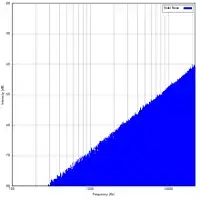
Blue and violet are the high-frequency counterparts of pink and brown respectively — blue rises 3dB per octave, violet at 6dB. Both weigh under 2MB for 10 seconds because high-frequency content compresses efficiently in FLAC. Less common in speaker testing but useful for evaluating tweeter response and identifying harshness above 8kHz.
Which file to download
Pink noise for calibration and room measurement — it’s the industry standard for a reason. Brown noise for subwoofer testing under sustained load. White noise if you’re masking rather than measuring. Gray noise if you’re working at varying volume levels and need perceptually flat content throughout. Blue and violet for high-frequency evaluation only.
All six files are lossless FLAC — what goes into the file is what comes out of your speakers.